Thyroid Cartilage Contouring Surgery (Adam's Apple Surgery)
Refines the neck profile through thyroid cartilage reduction or reconstruction so appearance better aligns with gender identity and overall contour balance.
Adam's apple surgery is not only one of the common facial feminization procedures for transgender women. In gender-affirming surgery for transgender men, Adam's apple reconstruction can also be used to increase the masculine contour of the neck, making the appearance more closely aligned with one's self-identity.
Adam's Apple Reduction Surgery for Transgender Women (MTF)
Thyroid cartilage contouring surgery, also known as Adam's apple reduction surgery, aims to reduce the prominence of the Adam's apple, making the neck contour softer and more natural while also taking vocal function and overall aesthetic proportion into consideration.
Regardless of the surgical approach used, vocal cord protection measures are applied during the procedure. The attachment site of the vocal cords and the safe range of cartilage reduction are assessed to avoid injury to the vocal cords and to prevent effects on vocal function, achieving a balance between aesthetic improvement and functional safety.
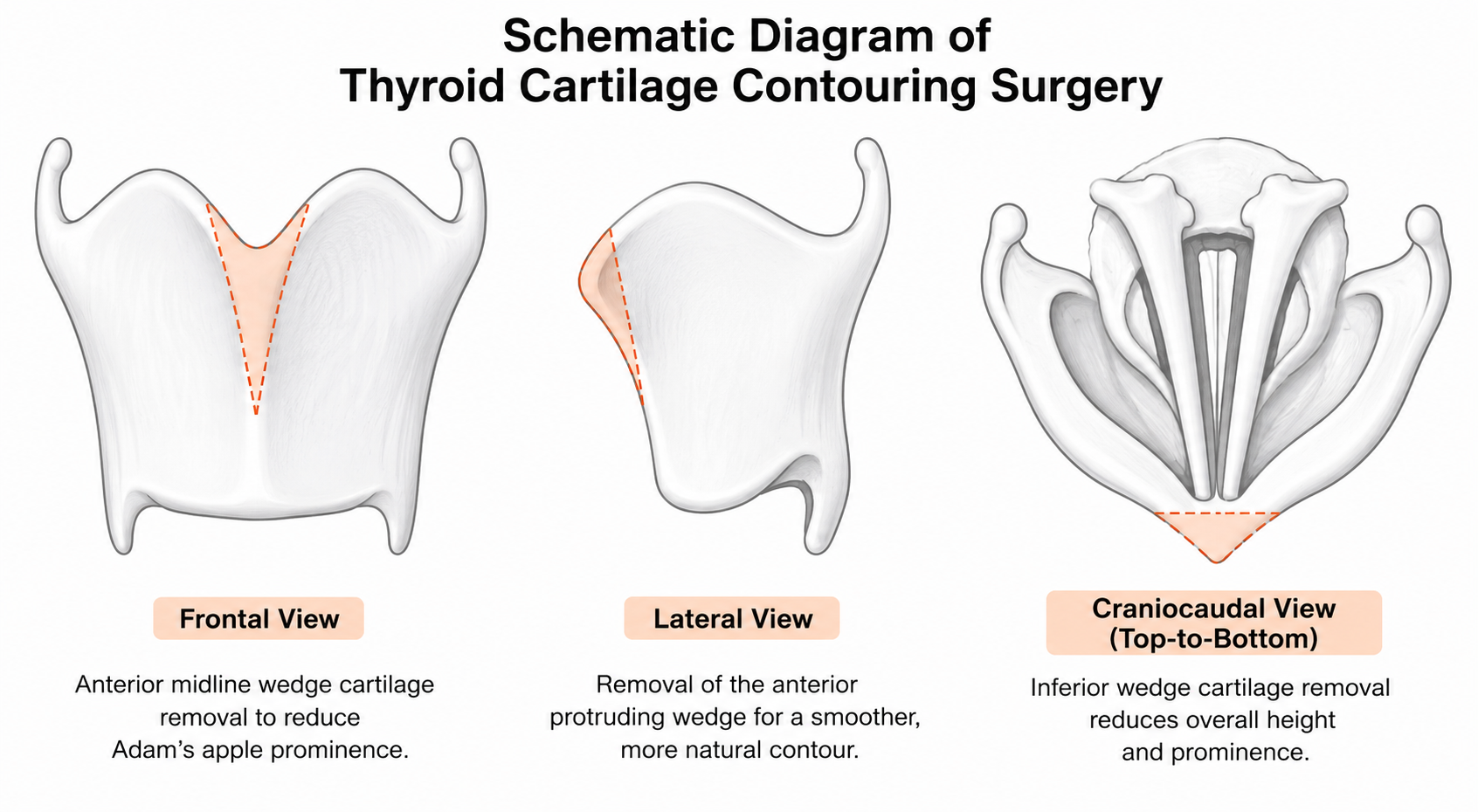
Endoscopic Thyroid Cartilage Contouring Surgery
With endoscopic assistance, thyroid cartilage reshaping can be performed with a clearer surgical field and more delicate manipulation, helping to precisely control the extent of cartilage reduction.
The incision is located inside the oral cavity, so there is no obvious external neck scar. After surgery, a one-day hospital observation is usually required to confirm the condition of the airway and postoperative swelling.
This approach is generally more suitable for individuals with mild Adam's apple prominence who prefer a lower recovery burden and a natural contouring effect.
Hidden-Scar Thyroid Cartilage Contouring Surgery
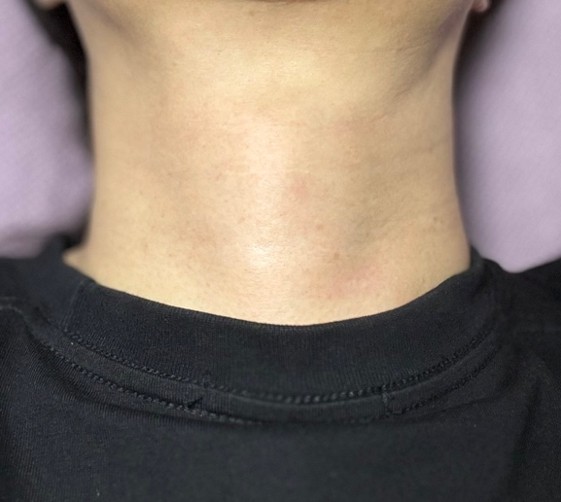
The incision is approximately 1.5 cm and is usually hidden within a natural neck crease. While maintaining scar concealment, this approach allows for more complete cartilage reshaping and contour adjustment.
This approach is more suitable for individuals with a more obvious Adam's apple or greater protrusion who hope to achieve a more significant improvement.
Surgical Case
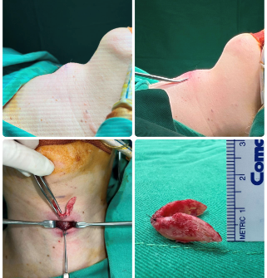
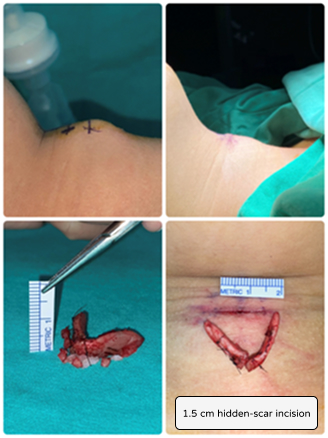
Postoperative scar hidden within the neck crease.
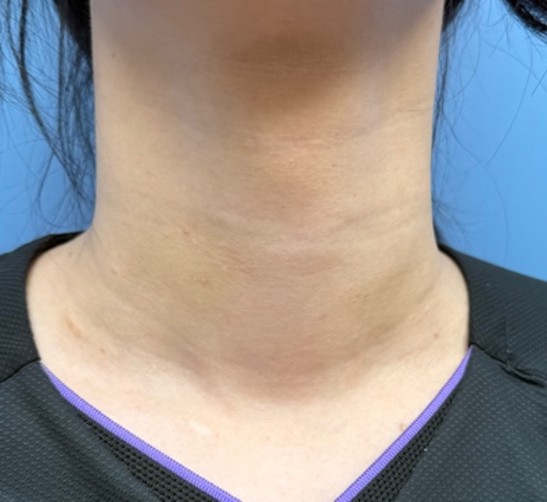
Postoperative Recovery: Endoscopic Thyroid Cartilage Contouring Surgery
- The incision is located inside the oral cavity, with no external neck scar.
- After surgery, a one-day hospital observation is usually required to confirm the condition of the airway and neck swelling.
- The intraoral wound gradually heals within 1–2 weeks after surgery. During this period, maintaining good oral hygiene is recommended.
- In the early stage, throat pain, a foreign-body sensation when swallowing, neck swelling, or tightness may occur, and these usually gradually improve.
- Within two weeks after surgery, avoiding strenuous exercise and excessive voice use is recommended.
- Most patients can return to daily life within a few days. The final contour generally takes approximately 3–6 months to gradually stabilize.
Postoperative Recovery: Hidden-Scar Thyroid Cartilage Contouring Surgery
- The incision is approximately 1.5 cm and is usually hidden within a natural neck crease.
- Mild neck swelling, bruising, tightness, or a foreign-body sensation when swallowing may occur after surgery and usually improves within several days to several weeks.
- After suture removal, normal wound cleaning and care can be performed, and the scar will gradually fade over time.
- Within two weeks after surgery, avoiding strenuous exercise and excessive neck extension is recommended.
- Most patients can return to work and daily activities within a few days. The final contour generally takes approximately 3–6 months to gradually stabilize.
- In the early postoperative period, mild voice fatigue or difficulty producing high-pitched sounds may occur. These are mostly temporary phenomena.
Possible Complications
Regardless of whether an endoscopic or hidden-scar approach is used, the following complications may occur, although the overall incidence is low:
- Postoperative swelling, bruising, or hematoma
- Wound infection
- Swallowing discomfort or foreign-body sensation
- Left-right asymmetry
- Insufficient Adam's apple reduction or residual prominence
- Excessive cartilage reduction causing an unnatural neck contour
- Temporary hoarseness, change in vocal range, or voice fatigue
- In very rare cases, vocal cord injury may occur, resulting in more persistent voice changes
Additional Possible Risks of Endoscopic Surgery
- Intraoral wound pain or delayed healing
- Infection of the oral mucosal wound
- Temporary numbness of the lower lip, gums, or tongue
Additional Possible Risks of Hidden-Scar Surgery
- More visible neck scar or hypertrophic scarring
- Wound adhesion causing tightness in the neck
- Local sensory abnormality or numbness
All thyroid cartilage contouring surgeries at our center include vocal cord protection measures during the procedure. Based on the preoperative evaluation, a safe range of cartilage reshaping is planned to achieve a natural and feminized neck contour while maintaining vocal function.
Adam's Apple Reconstruction Surgery for Transgender Men (FTM)
Some transgender men have less prominent thyroid cartilage by nature. Even after receiving hormone therapy, the neck contour may still lack a distinct Adam's apple line.
Adam's apple reconstruction surgery uses the patient's own rib cartilage, which is carved and then fixed to the anterior aspect of the thyroid cartilage to simulate the three-dimensional contour and angle of a male Adam's apple, giving the neck a more masculine appearance and male characteristics.
Because the patient's own tissue is used, the risk of rejection and infection can be reduced. At the same time, the shape and degree of projection can be customized according to individual conditions to achieve a natural and harmonious neck proportion.
Changes in detail are not only about appearance, but also a complete expression of self-identity.
Surgical Method
Adam's Apple Augmentation mainly uses autologous rib cartilage for carving and transplantation to reconstruct the protruding contour in front of the male thyroid cartilage, making the neck contour more consistent with masculine characteristics.
Preoperative Evaluation
Before surgery, the following will be evaluated:
- Thickness of the neck soft tissue
- Original thyroid cartilage contour
- Facial and mandibular proportions
- The patient's desired degree of Adam's apple projection
- Conditions of the rib cartilage donor site
The height, width, and projection angle of the Adam's apple are planned according to the individual anatomical conditions.
Surgical Steps 1. Rib Cartilage Harvesting
A small amount of rib cartilage is harvested through an approximately 2–3 cm incision at the lower chest margin, usually from the sixth or seventh rib cartilage.
After harvesting, chest wall stability is preserved, and careful hemostasis and layered closure are performed.
Surgical Steps 2. Customized Cartilage Carving
According to the preoperative design, the rib cartilage is carved into a shape similar to the anterior angle of the male thyroid cartilage, also known as the laryngeal prominence.
- Projection height
- Width
- Sharpness
- Left-right symmetry
This is done to match the degree of masculinization the patient wishes to present.
Surgical Steps 3. Minimally Invasive Neck Incision
A hidden incision is designed along a natural neck crease.
A recipient pocket is created in front of the thyroid cartilage, avoiding effects on the vocal cords and important laryngeal structures.
Surgical Steps 4. Adam's Apple Reconstruction and Fixation
The carved rib cartilage is precisely placed in front of the thyroid cartilage.
- Mini titanium plate
- Mini bone screw
- Non-absorbable suture
These fixation methods are used as needed to prevent postoperative displacement while left-right symmetry and the anterior projection angle are adjusted.
Surgical Steps 5. Contour Refinement and Wound Closure
After confirming the overall neck appearance and proportion, final contour refinement is performed.
A drainage tube may be placed depending on the situation, and the wound is closed in layers.
The wound is usually hidden within a neck crease.
Features of This Surgery
- Uses autologous rib cartilage, without the problem of artificial implant rejection
- The size and angle of the Adam's apple can be customized according to individual needs
- Natural appearance, with a texture close to native tissue
- Good stability and less likelihood of long-term foreign-body reaction
- Can be planned together with facial masculinization surgery (FMS) and mandibular masculinization surgery
Anesthesia
The procedure is usually performed under general anesthesia. The surgical time is approximately 2–3 hours, depending on the complexity of cartilage carving and fixation.
Scar Location
- Neck: approximately 2–3 cm, hidden within a neck crease
- Chest: approximately 2–3 cm, located near the lower chest margin or inframammary fold
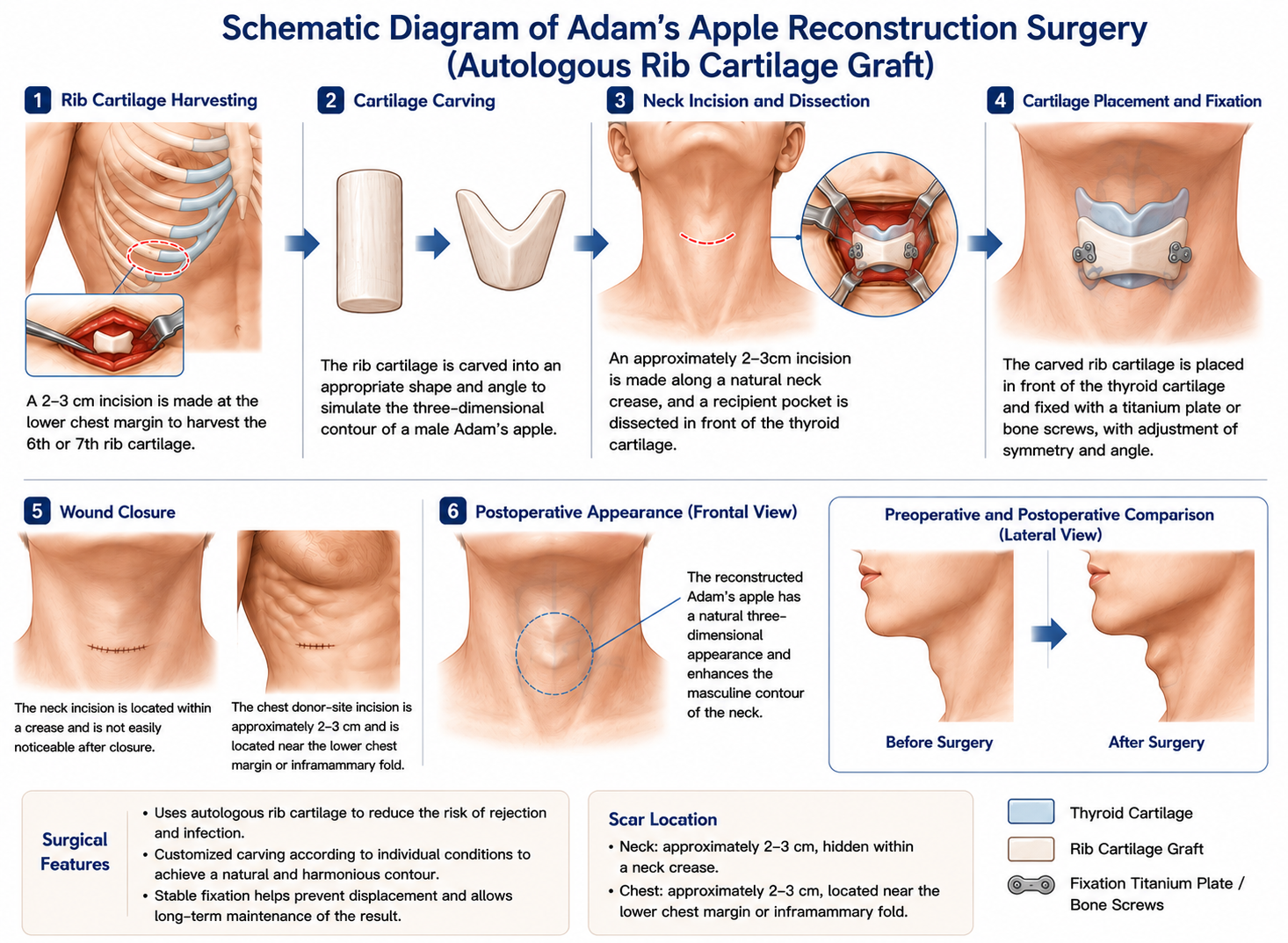
In most patients, the scars are not easily noticeable after scar maturation.
Postoperative Recovery
- After surgery, swelling, tightness, and mild pain may occur in the anterior neck and usually gradually improve within several days to several weeks.
- The rib cartilage harvest site, usually located at the lower chest margin, may have localized pain or discomfort with movement and usually gradually recovers within several weeks.
- After surgery, avoiding strenuous exercise, weight training, and direct impact to the neck for approximately 4–6 weeks is recommended to allow stable cartilage healing.
- In the early stage, the Adam's apple area may feel relatively stiff or have a foreign-body sensation. This often gradually decreases as the tissues adapt.
- Most patients can return to daily life and work within 1–2 weeks after surgery.
- Postoperative swelling gradually subsides over approximately 1–3 months, and the final Adam's apple contour usually takes 3–6 months to stabilize.
- Because autologous rib cartilage is used, it can gradually integrate with the surrounding tissue after implantation, achieving a natural and stable appearance.
Possible Complications: Adam's Apple Reconstruction Area
All surgeries carry risks. Although the incidence is low, possible complications may include:
- Postoperative hematoma or swelling
- Wound infection
- Asymmetry between the two sides of the Adam's apple
- Cartilage contour that is too prominent or insufficient
- Cartilage displacement, rotation, or partial absorption
- A locally firm texture or palpable contour edge
- Local sensory abnormality or numbness
- Hypertrophic scarring or a more visible scar
Possible Complications: Voice-Related Risks
Because the surgery is mainly performed on the outer side of the thyroid cartilage, it usually does not affect the vocal cord structure or vocal function. However, in very rare cases, the following may still occur:
- Temporary voice fatigue
- A sense of voice instability
- Foreign-body sensation when swallowing
Possible Complications: Risks Related to Rib Cartilage Harvesting
- Pain at the cartilage harvest site or chest wall discomfort
- Hematoma or infection
- Local depression or contour irregularity
- Hypertrophic scarring
- In very rare cases, pneumothorax may occur
Long-Term Effect
Because autologous rib cartilage is used for reconstruction, the risk of foreign-body rejection and chronic infection can be reduced. Before surgery, customized cartilage carving is planned according to the individual neck proportion, thyroid cartilage angle, and overall masculinization needs. The goal is to achieve a balance between a natural appearance and masculine characteristics, creating an Adam's apple contour that fits the individual facial and neck proportions.