Peritoneal Vaginoplasty
Peritoneal vaginoplasty uses peritoneal tissue to create the vaginal lining, and reconstructs the vaginal canal through laparoscopic or robotic-assisted surgery.
The peritoneum has good extensibility and self-repair capacity, and can provide a soft and elastic vaginal lining while avoiding large-area skin grafting. It is one of the vaginoplasty techniques that has been widely developed in recent years.
Main Advantages
- Good tissue extensibility
- Minimally invasive surgery through laparoscopy or robotic assistance
- Soft and elastic vaginal lining
- No need to use bowel tissue
- Can serve as an option for certain revision surgeries
Suitable Candidates
- Those who wish to avoid bowel surgery
- Those with insufficient tissue volume but who are not suitable for intestinal vaginoplasty
- Those who have previously undergone vaginoplasty and require partial reconstruction
Possible Limitations
- Requires laparoscopic or robotic-assisted surgery
- Natural lubrication is usually not as good as intestinal vaginoplasty
- Long-term depth stability may be affected by postoperative dilation
- Some patients may still require auxiliary skin or scrotal tissue reconstruction
Possible Complications
- Intra-abdominal bleeding
- Peritoneal injury
- Bladder or rectal injury
- Vaginal stenosis
- Loss of depth
- Poor wound healing
- Intra-abdominal adhesions
- Abdominal abscess
- Vaginal prolapse
Surgical Time and Recovery Period
- ⏱️ Surgical Time: Approximately 6–8 hours
- 🏥 Hospital Stay: Approximately 5–10 days
- 🔄 Recovery Period: Approximately 6–8 weeks
- 📏 Start Time for Dilation: Approximately 10–14 days after surgery
Features of Our Center: Total Peritoneal Vaginoplasty Technique
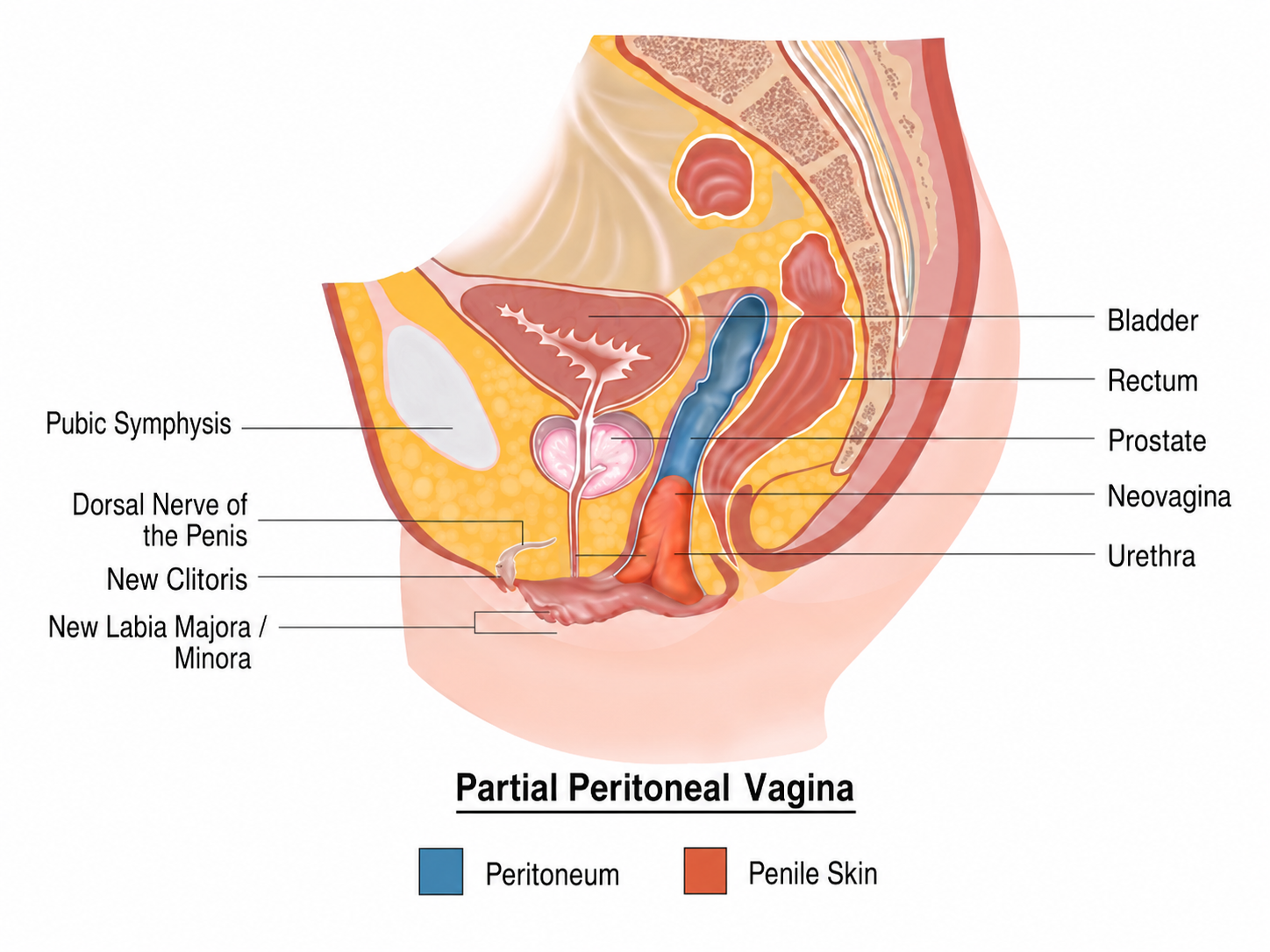
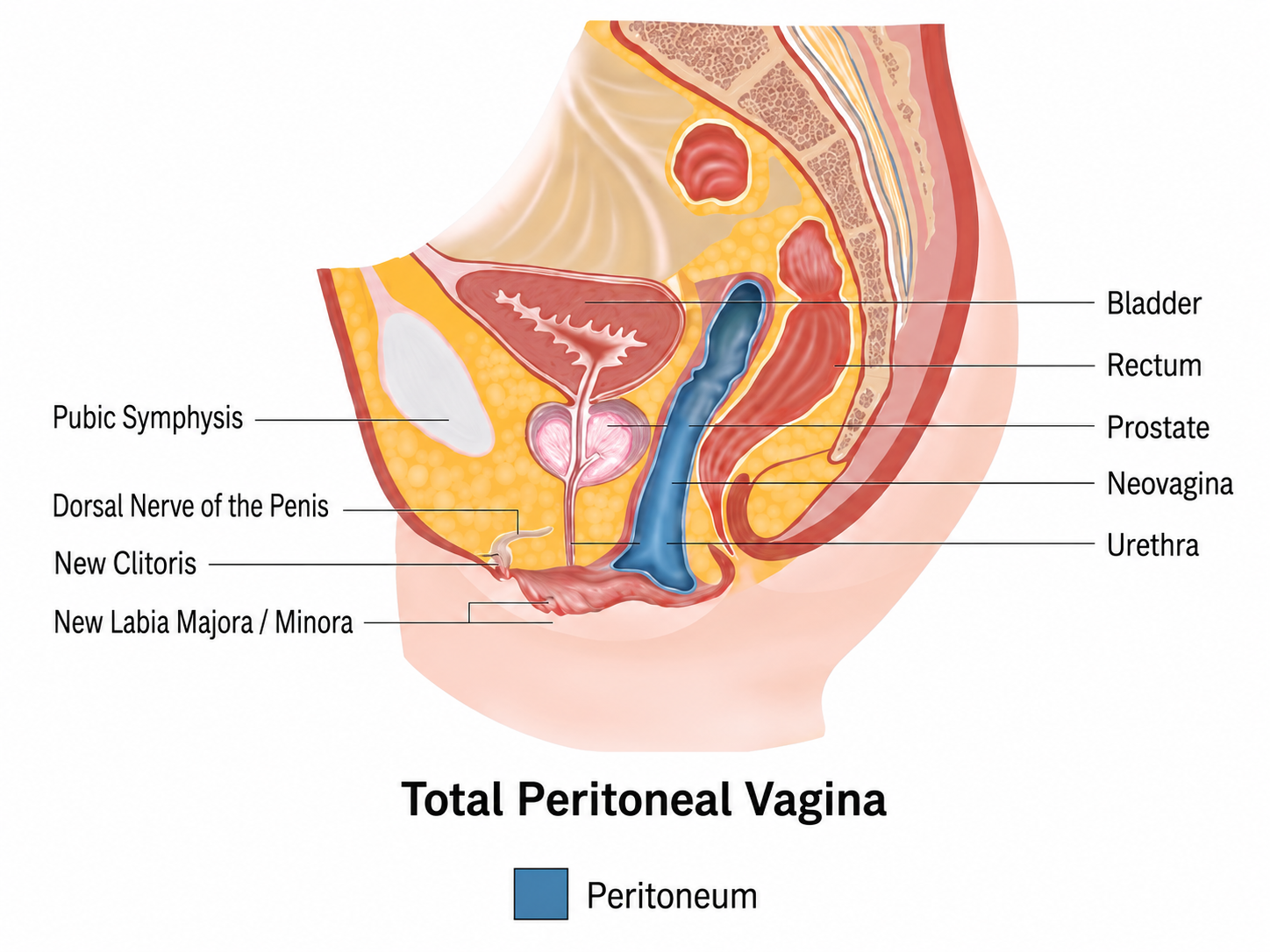
In addition to traditional peritoneal vaginoplasty, our center also provides partial peritoneal vaginoplasty and total peritoneal vaginoplasty.
Through microsurgical techniques combined with intraoperative fluorescence perfusion assessment (ICG angiography), peritoneal tissue with preserved perforator vessels, or a pedicled peritoneal flap, is used to reconstruct the entire vaginal lining, in order to maintain tissue blood supply and long-term survival.
- 🩸 Preservation of Blood Supply: Vascularized peritoneal tissue has more stable perfusion and healing capacity.
- 📏 Reconstruction of the Entire Vagina: The peritoneum can be used to reconstruct the entire vaginal canal, rather than only supplementing part of the depth.
- 🩹 Reduced Risk of Tissue Contraction: Good blood circulation helps reduce contracture and loss of depth.
- 🔬 Microsurgery Combined with ICG Perfusion Assessment: Blood-flow status is confirmed in real time during surgery, improving tissue survival rate and surgical safety.
- ✨ A New Generation of Vaginal Reconstruction Technology: Combining minimally invasive surgery, microsurgery, and blood-flow monitoring technology, this provides a more precise and customized vaginal reconstruction option.
Postoperative Neovagina Diagram
Divided into partial peritoneal vagina and total peritoneal vagina.

Key points
- Good tissue extensibility
- Minimally invasive laparoscopy/robotic surgery
- Applicable for selected revision or limited-tissue cases
- Our center uses microsurgery with ICG perfusion assessment